
Life on Earth ultimately relies on photosynthesis, the reaction that turns sunlight into energy to fuel plant growth, which feeds all animals, including us humans. This is what I was taught in school. Every living thing is alive because of sunshine.
6 CO2 + 6 H2O + solar energy -> C6H12O6 + 6 O2
(Photosynthesis reaction)
But it turns out sunshine isn’t the only source of energy for living beings. Back in 1977 scientists discovered life in the dark, sunlight-less depths of the Pacific Ocean, where no life was thought to be able to exist. They found a garden of thriving tubeworms and other previously undiscovered creatures living around hydrothermal vents. Other types of lightless gardens have since been found around cold seeps in the depths of the ocean.
What is the energy source for these deep-sea creatures’ life? Nutrients flowing out of the Earth itself are converted by microbes into food. Hydrothermal vents emit hydrogen sulfide which reacts with oxygen to produce chemical energy which in turn fixes carbon dioxide into glucose. Cold seeps emit methane, which reacts with oxygen to produce chemical energy, which in turn fixes carbon-based molecules into glucose. Use of this form of chemical energy to fuel life is called chemosynthesis.
H2S + 2O2 -> SO4-2 + 2H+ + energy released
energy from previous reaction + CO2 + other organic molecules -> C6H12O6
(Hydrogen Sulfide Chemosynthesis reaction)
These deep-sea microbes are food for other deep-sea creatures such as tubeworms and mussels.
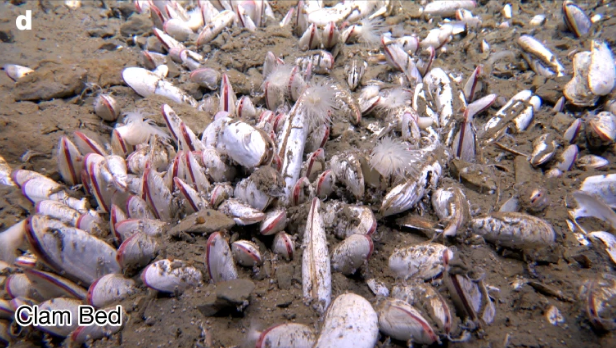
In July 2025, Chinese scientists published results of a trip to the bottom of the Kuril-Kamchatka trench and Aleutian trench in their manned submersible, Fendouzhe. (Yes, the Chinese have a manned submersible and it’s previously been to the bottom of the Mariana Trench, the deepest place in the ocean. How did we not know about this?) They found colonies of free moving marine worms, tube worms, and clams up to 10” long at depths of over 9500 meters (31,276 feet at the deepest).
This deep-sea life is carbon-based and has DNA like all other life on earth. It is thought that the chemosynthetic reactions that fuel life predate the photosynthetic reaction that we are so familiar with. At some point bacteria gained the ability to use photosynthesis as an energy source.
But what about here on the surface of the Earth? Are there microbes here that use chemosynthesis rather than photosynthesis? The amazing answer is yes! When we add elemental sulfur to the soil, we know that soil microbes oxidize it into the sulfate form that plants take up, lowering the soil pH in the process. It has only recently been discovered that in the process, the soil microbes also remove CO2 from the atmosphere, storing it in their bodies. The exact metabolic details are still unknown but overall, the microbial life is using the energy from the S -> SO4-2 reaction to grow! All of this happens without the addition of sunlight and without photosynthesis.
Life is wonderful, mysterious and oh so interesting!
References:
A ‘vibrant oasis’ of chemical-eating creatures found in the deep Pacific (Reuters)
Flourishing chemosynthetic life at the greatest depths of hadal trenches (Nature)
https://www.nature.com/articles/s41586-025-09317-z
Chemosynthesis fact sheet (NOAA)
https://oceanexplorer.noaa.gov/edu/materials/chemosynthesis-fact-sheet.pdf
Early Evolution of Photosynthesis (Plant Physiology)
https://pmc.ncbi.nlm.nih.gov/articles/PMC2949000/
Large perturbations in CO2 flux and subsequent chemosynthesis are induced in agricultural soil by the addition of elemental sulfur


